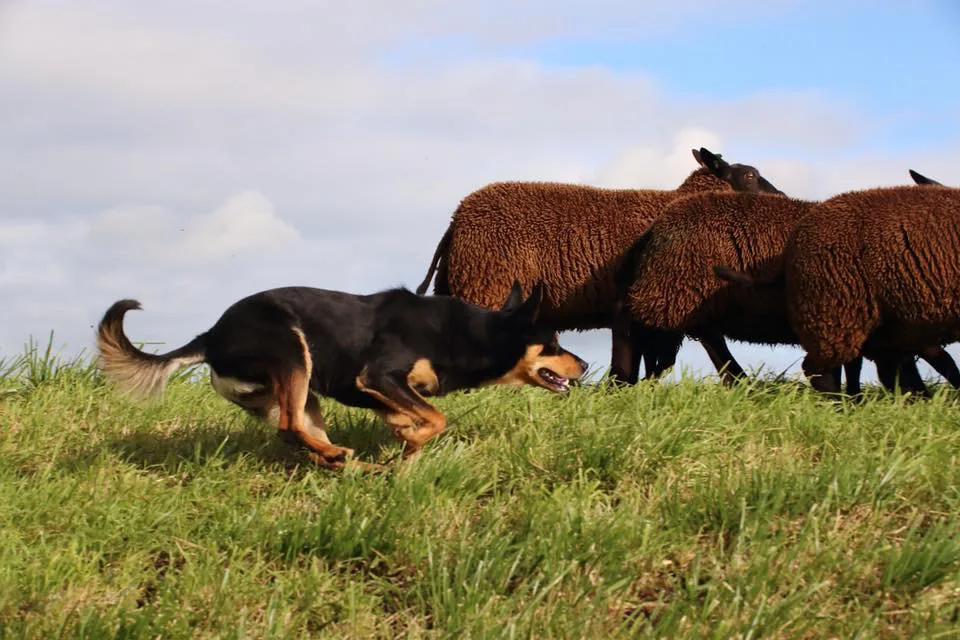
- Health in Working Kelpie parent dogs goes beyond merely “looking fit”.
- Enquire about general health, hereditary points of attention, workload, and recovery capacity.
- In working lines, temperament, resilience, and practical performance with livestock are equally important.
- A good breeder openly discusses strengths, points of attention, and the match with the puppy buyer.
- Shepherds Working Kelpies evaluates parent dogs based on practical work with the flock in Doldersum, Drenthe.
- Why health is so important in working lines
- Which health checks can you discuss?
- Health, temperament, and working ability go hand in hand
- Questions to ask the breeder
- Practical experience in Doldersum
- Step-by-step guide for puppy buyers
- Frequently asked questions
Why health is so important in working lines
A Working Kelpie from working lines is not kept merely as a companion dog, but is often used for serious work with sheep, ducks, geese, or other livestock. This requires a dog that is physically resilient, recovers well, maintains clear focus, and continues to cooperate effectively under pressure. Health is therefore directly linked to working ability.
When choosing a puppy, it is essential not only to ask whether the parent dogs are “healthy”, but also how they perform in practice. Are they capable of working for sustained periods? Do they recover well after exertion? Are they stable in their behaviour? Do they remain responsive around livestock? In working lines especially, this combination reveals a great deal about the future puppy.
Which health checks can you discuss?
Which screening tests are relevant may vary by bloodline, country, breeding program, and individual dog. It is therefore advisable not to regard a single fixed checklist as an absolute guarantee, but to enquire specifically about health, hereditary points of attention, previous litters, and the performance of the parent dogs. A reputable breeder can explain which decisions have been made and why.
| Topic | What to ask? | Why is this important? |
|---|---|---|
| General health | Are the parent dogs fit, capable of working, and free from known serious health issues? | A working dog must be physically reliable and able to recover effectively. |
| Hereditary points of attention | Are there known conditions or points of attention in the line that are being monitored? | Transparency helps puppy buyers make informed, realistic choices. |
| Workload | How do the parent dogs work in practice and how do they hold up under physical and mental load? | In working lines, performance in real work is a key element of breeding selection. |
| Temperament and recovery | Do the dogs remain stable, responsive, and able to relax after high arousal? | A dog that is physically fit but cannot recover mentally can still be difficult to work with. |
Health, temperament, and working ability go hand in hand
In a Working Kelpie, health cannot be separated from temperament and working ability. A dog may appear strong and energetic at first glance, yet still struggle with prolonged workloads, stimulus processing, or recovery after intensive work. Conversely, a stable, well-structured dog with solid working instincts can provide valuable service in the field for years to come.
That is why a dedicated breeder looks beyond paperwork to daily performance. How does the dog move? How does it work with sheep? How does it handle pressure? Can it think independently without becoming uncontrollable? And does it remain calm and manageable after work is done?
Questions to ask the breeder
A puppy buyer does not need to be a veterinarian or breeding expert to ask the right questions. What matters is that you enquire openly about health, the working line, the parent dogs, and any relevant points of attention. A trustworthy breeder will not only highlight positive traits, but also explain what you should take into consideration.
For instance, ask which parent dogs are being used, why this specific pairing was chosen, what traits are expected in the litter, and whether information is available about previous offspring. Also enquire whether the parent dogs work daily or primarily train occasionally. For a Working Kelpie, practical work often says a great deal about stamina, resilience, and temperament.
Practical experience in Doldersum
Shepherds Working Kelpies operates from Doldersum, Drenthe, near the Drents-Friese Wold. The dogs are not evaluated merely on breed standard appearance or sporting aptitude, but through actual work with a flock. This makes the conversation about health concrete: a dog must be able to perform in practice.
As a qualified veterinary nurse and long-time Animal Care lecturer, Erika Visser brings extensive knowledge of animal health, care, and behaviour. As a second-generation shepherd, Catrinus Homan assesses working ability, resilience, and practical usability with the flock. This combination helps puppy buyers look beyond pedigree papers, coat colour, or first impressions alone.
Step-by-step guide for puppy buyers
- Ask about the parent dogs. Discuss health, temperament, working experience, and why this specific pairing was chosen.
- Look beyond paperwork. Documentation is useful, but daily performance with livestock provides essential context.
- Discuss hereditary points of attention. Ask openly whether there are known susceptibilities or risks within the line.
- Pay attention to recovery capacity. A good working dog must not only work hard, but also be able to settle and relax.
- Enquire about post-purchase support. Ensure you can reach out after purchase with questions regarding growth, training, workload, and behaviour.
Enquire about parent dogs and health information
Frequently asked questions about health checks for Working Kelpie parent dogs
Enquire about the general health of the parent dogs, known hereditary points of attention, previous litters, temperament, workload, and recovery capacity. With a Working Kelpie from working lines, it is important that the parent dogs do not merely look fit, but also perform well in practice with livestock.
Are health checks only important for show dogs?
No, health checks are just as crucial for working dogs. A Working Kelpie must be physically and mentally resilient, as it is often deployed with sheep, ducks, or other livestock. Health, temperament, and working ability together determine whether a dog can function responsibly and sustainably.
Does a healthy parent dog guarantee a healthy puppy?
No, the health of parent dogs never provides a complete guarantee, but it does reduce risks and provide valuable information. A conscientious breeder evaluates health, temperament, working instinct, and known line-specific considerations. Transparency upfront helps puppy buyers establish realistic expectations.
Why is practical work with the parent dogs important?
Practical work demonstrates how parent dogs behave under genuine working pressure. You can observe whether a dog handles pressure well, moves soundly, cooperates, recovers, and remains stable around livestock. For a Working Kelpie, this often reveals far more than a general description or a photograph.
What if a breeder does not provide clear health information?
If a breeder does not provide clear health information, it is advisable to ask further questions and avoid rushing into a decision. Ask about parent dogs, potential considerations, practical working experience, and post-purchase guidance. When in doubt, honest advice is more important than quickly reserving a puppy.
Related articles
- How to choose a Working Kelpie puppy from working lines?
- Can I buy a Working Kelpie puppy if I do not have livestock?
- What is the difference between a Working Kelpie and an Australian Kelpie?
- Working Kelpie training for sheep herding