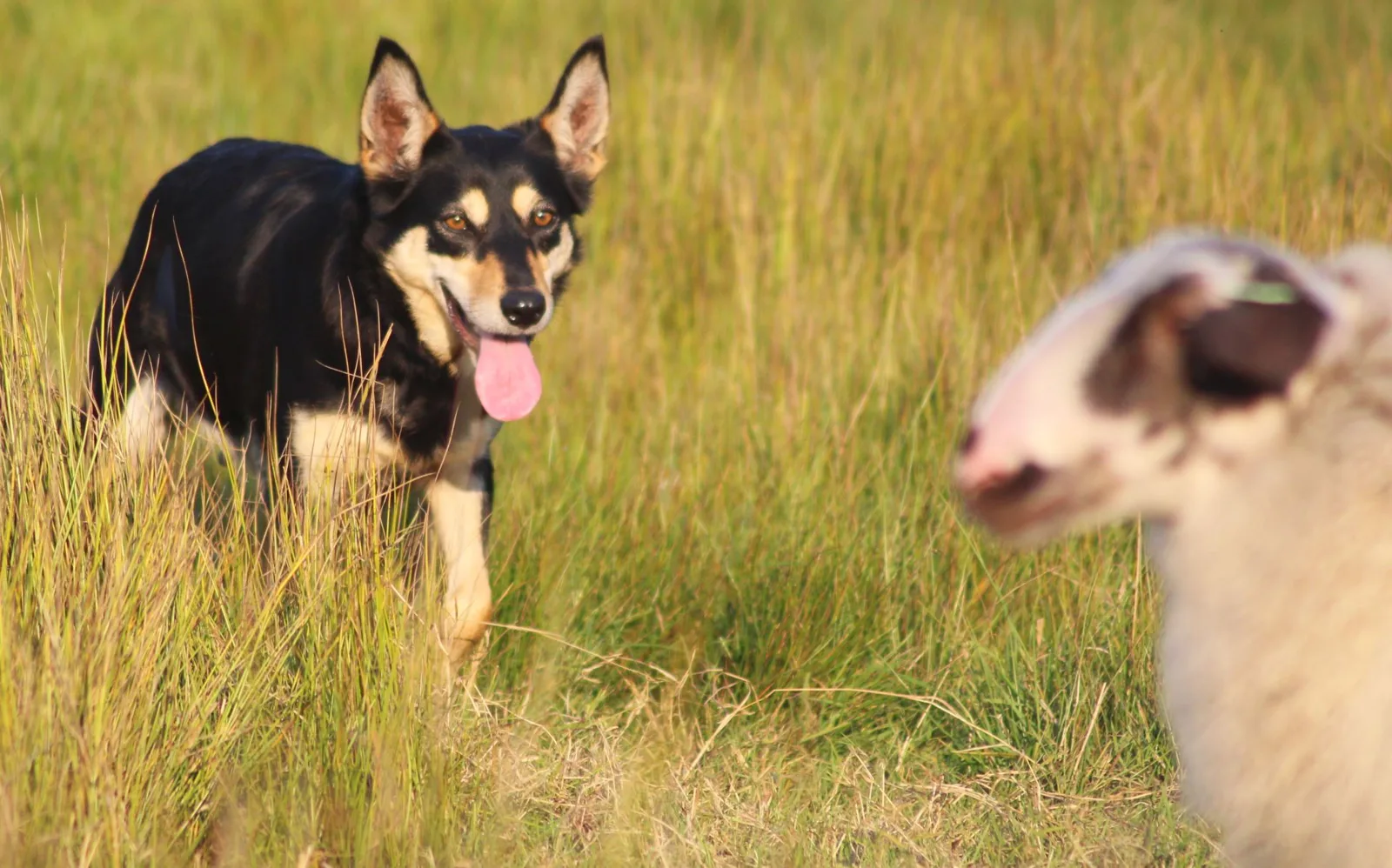
- A Working Kelpie is primarily a working dog for livestock, sheep, and practical flock work.
- A regular Australian Kelpie is more frequently evaluated on breed standards, appearance, and show suitability.
- In working lines, traits such as stock sense, stamina, balance, pressure control, and independence carry significant weight.
- For sheep herding, a dog from proven working lines is usually a more logical choice than a dog from show lines.
- Shepherds Working Kelpies evaluates dogs based on practical work with an actual flock of sheep in Doldersum, Drenthe.
- Brief explanation of the difference
- What makes a Working Kelpie different?
- What do people mean by a regular Australian Kelpie?
- The practical difference with livestock
- Which Kelpie suits your situation?
- Advice based on practical experience in Doldersum
- Frequently asked questions
Brief explanation of the difference
The terms Working Kelpie and Australian Kelpie are often used interchangeably, but in practice, people usually refer to two distinct breeding directions. The Working Kelpie is focused on functional work with livestock. The regular Australian Kelpie is more frequently associated with show lines, breed standards, and conformation.
This difference is important for anyone looking for a Kelpie. A dog from working lines can possess substantial working drive, independence, and stock sense. While this is invaluable for shepherds and livestock farmers, it also requires knowledge, guidance, and a suitable environment. A dog from show lines may conform more closely to the breed standard in appearance, but does not automatically possess the same practical working traits.
What makes a Working Kelpie different?
A Working Kelpie is evaluated by what it can accomplish in the field. This includes gathering sheep, moving stock, reading pressure, maintaining distance, thinking independently, and yet continuing to cooperate with the handler. In working lines, the primary focus is not on colour, conformation, or presentation, but on practical utility.
Key traits include stock sense, stamina, balance, trainability, and resilience. A good Working Kelpie must not only be able to work hard, but also switch gears, relax, and remain controlled around livestock. It is precisely this combination that makes the breed invaluable for practical flock management.
What do people mean by a regular Australian Kelpie?
By a regular Australian Kelpie, people often mean a Kelpie from show or breed standard lines. These dogs can be active, intelligent, and athletic, but they are typically selected differently from dogs of pure working lines. In show lines, appearance, conformation, colour, movement, and the breed standard carry greater significance.
This does not mean that an Australian Kelpie from show lines is “inferior”. It primarily means that the breeding objective is different. For an active household, dog sports, or companionship, a less pronounced working profile may sometimes be more suitable. For daily work with sheep or other livestock, a proven working line is usually the logical choice.
The practical difference with livestock
The difference between both lines becomes particularly apparent when the dog works with livestock. A Working Kelpie from quality working lines generally possesses a greater aptitude for reading pressure, distance, and animal movement. The dog quicker understands where to position itself to move a flock without causing unnecessary unrest.
| Aspect | Working Kelpie | Regular Australian Kelpie |
|---|---|---|
| Breeding goal | Working qualities, stock sense, stamina, and practical usability. | More often breed standards, appearance, conformation, and show suitability. |
| Primary evaluation | How the dog performs around livestock and cooperates with the handler. | How the dog conforms to the desired breed standard and conformation. |
| Suitable for | Shepherds, livestock farmers, serious handlers, and practical stock herding. | Active owners, dog sports, show, or companionship, depending on the dog and line. |
| What to look for? | Working parents, temperament, mental resilience, training, and guidance. | Health, temperament, bloodline, energy levels, and suitability for the family or sporting goals. |
Which Kelpie suits your situation?
If you are looking for a dog for sheep herding, stock handling, managing a flock, or serious training with livestock, a Working Kelpie from proven working lines is usually the best choice. The dog has been selected for the specific traits required for that work, such as keeping distance, regulating pressure, demonstrating initiative, and collaborating with the handler.
If you are primarily looking for an active family companion or a sporting dog without livestock, a Working Kelpie is not necessarily the easiest option. A dog with strong working instinct can become restless, controlling, or prone to chasing stimuli without appropriate work. In such situations, honest advice is far more important than choosing based solely on breed or appearance.
Advice based on practical experience in Doldersum
Shepherds Working Kelpies operates from Doldersum, Drenthe, near the Drents-Friese Wold National Park. The dogs are evaluated through real work with a flock of sheep. As a result, the difference between show lines and working lines is not merely explained theoretically, but assessed from daily practical experience.
Erika Visser brings expertise in animal health, behaviour, and animal care. Catrinus Homan contributes practical experience as a second-generation shepherd. Together, they assess health, temperament, working instinct, and whether a Working Kelpie is truly the right match for the prospective owner.
Frequently asked questions about Working Kelpie versus Australian Kelpie
The primary difference lies in the breeding objective. A Working Kelpie is selected for working qualities such as stock sense, stamina, independence, and trainability. A regular Australian Kelpie more commonly originates from show or breed standard lines, where appearance, conformation, colour, and ring presentation carry more weight.
Is a Working Kelpie better than an Australian Kelpie?
A Working Kelpie is not automatically better; it is simply better suited to practical livestock work. For sheep herding, stock driving, and daily flock management, a proven working line is usually the more logical choice. For dog sports, companionship, or an active household, a less pronounced working line may sometimes integrate better into the living environment.
Can a regular Australian Kelpie also work with sheep?
Occasionally, an Australian Kelpie from show or mixed lines may display an interest in sheep, but that is not the same as proven working instinct. In serious flock management, what matters is whether the dog can read pressure, maintain distance, find balance, and work independently. These traits have been far more purposefully selected in genuine working lines.
Why is the difference between show lines and working lines important for puppy buyers?
The distinction is crucial because the dog must suit its future lifestyle. A puppy from working lines can possess strong working drive and high independence. While valuable around livestock, this demands knowledge, training, and clear guidance. Choosing primarily based on appearance can lead to unexpected challenges regarding the dog's need for work and direction.
How do I know if a Working Kelpie is right for me?
You can only determine this accurately through an honest discussion regarding your experience, living environment, access to livestock, training plans, and expectations. A Working Kelpie is best suited to people who understand its working drive and can provide appropriate management. When in doubt, seeking advice from a practical breeder or shepherd is highly recommended.
Related articles
- What is the difference between a Working Kelpie and an Australian Kelpie?
- Which Working Kelpie breeder in the Netherlands works with a real flock?
- How do you choose a Working Kelpie puppy from working lines?
- Working Kelpie training for sheep herding