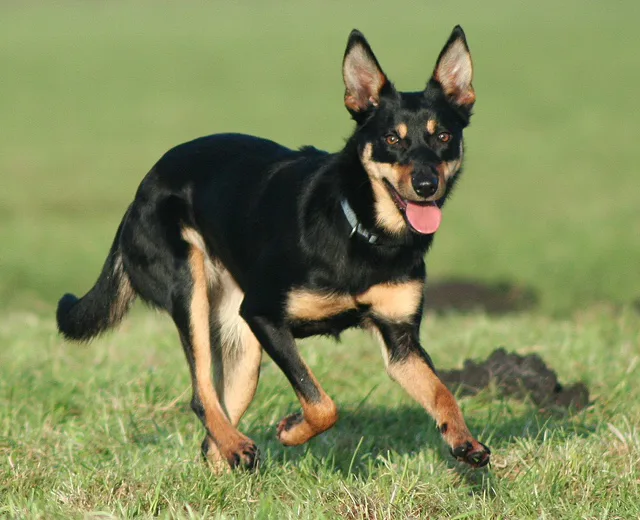
- Low stress stock handling centers on calmness, timing, distance, and reading livestock.
- A Working Kelpie uses its position and herding instinct to move animals without unnecessary pressure.
- The handler primarily learns to observe: when does movement, tension, or relaxation arise within the flock?
- This method is well suited to working lines because Working Kelpies can independently read and regulate pressure.
- At Shepherds Working Kelpies, this approach is grounded in daily practical experience with dogs and herds in Doldersum, Drenthe.
- What is low stress stock handling?
- Why is this suitable for Working Kelpies?
- Difference from rushed herding
- The role of handler and dog
- Practical experience in Doldersum
- When to pursue training?
- Frequently asked questions
What is low stress stock handling?
Low stress stock handling means moving livestock in a calm, clear, and predictable manner. The objective is not to move animals from point A to point B as quickly as possible, but to help them understand which way to go with minimal stress. Timing, position, distance, and calmness are far more important than force or noise.
When working with a Working Kelpie, it is not merely about giving commands. The handler must learn to recognize when the herd relaxes, when animals experience pressure, and when the dog is positioned too close to the livestock. A good Working Kelpie can often sense this pressure naturally, but must still learn how to apply its instinct in a controlled manner.
Why is this suitable for Working Kelpies?
Working Kelpies are bred to work practically with livestock. They must be able to think independently, maintain distance, apply pressure, and release it when appropriate. This makes them exceptionally well suited for low stress stock handling: the dog uses its position and presence to create movement without unnecessarily alarming the livestock.
A Working Kelpie from working lines often possesses high energy and initiative. This is valuable, but only when properly guided. Without calm and structured training, this working drive can lead to excessive pressure, approaching too forcefully, or chasing animals. Through low stress stock handling, the dog learns that restraint is just as essential as speed.
Difference from rushed herding
The primary difference between low stress stock handling and rushed herding lies in the effect on the livestock. In rushed herding, animals often move out of panic or flight response. In low stress stock handling, movement occurs because the handler and dog choose the correct position and carefully meter the pressure.
| Aspect | Low stress stock handling | Rushed herding |
|---|---|---|
| Objective | Moving livestock in a calm, controlled, and predictable manner. | Getting livestock moving as quickly as possible. |
| Pressure | Pressure is applied and released as soon as the livestock responds. | Pressure often remains too high, causing flight behavior. |
| Role of the dog | The dog works using position, distance, balance, and calmness. | The dog chases or pushes the livestock forward too forcefully. |
| Effect on livestock | Less stress, better situational awareness, and easier-to-guide animals. | More unrest, breaking out, turning back, or collisions within the group. |
The role of handler and dog
In low stress stock handling, the handler is just as vital as the dog. The handler determines where pressure is created, when the dog should give space, and when the dog may move in closer. A subtle shift in position can be sufficient to turn a flock, slow it down, or keep it moving steadily.
Meanwhile, the dog learns to respond to the situation as well as to the handler. This requires balance. Too many commands can make a young dog uncertain, whereas too little guidance can result in uncontrolled work. Proper training helps the dog understand when it may resolve a situation independently and when it must wait for direction.
Practical experience in Doldersum
Shepherds Working Kelpies operates from Doldersum, Drenthe, near the Drents-Friese Wold National Park. This practical environment is essential: dogs do not only learn on a training field, but are evaluated through genuine herd work, dynamic situations, and practical collaboration with animals.
Erika Visser contributes expertise in animal health, behavior, and care. Catrinus Homan brings his extensive experience as a 2nd generation shepherd. This combination makes the guidance on low stress stock handling highly practical: focusing not only on theoretical principles, but on how dog, handler, and livestock maintain calm, effective teamwork in daily practice.
When to pursue training?
Seeking training is advisable as soon as you plan to work your Working Kelpie on sheep, ducks, or other livestock. This is especially true for young dogs, novice handlers, and owners who notice that their dog possesses strong natural drive but applies excessive pressure. Early guidance prevents undesirable habits that become far more difficult to correct later on.
Inquire about training in low stress stock handling
Frequently asked questions about low stress stock handling with Working Kelpies
Low stress stock handling means moving livestock in a calm and predictable manner with minimal tension. With Working Kelpies, this is achieved through the effective use of position, distance, timing, and pressure. The dog learns to move livestock without unnecessary chasing, while the handler learns when to apply or release pressure.
Why is calmness so important when working with sheep?
Calmness is essential because sheep and other livestock respond much better when they are not in a state of panic. If pressure becomes too high, animals may break out, turn back, or freeze. A calm dog and handler ensure that the flock maintains composure and moves smoothly in the intended direction.
Can every Working Kelpie learn low stress stock handling?
Many Working Kelpies have a natural aptitude for reading pressure and movement in livestock, but every dog must learn how to use this instinct in a controlled manner. Temperament, age, experience, working lineage, and guidance all play a role. A dog with strong working drive often requires particularly clear and composed training.
Is low stress stock handling the same as obedience training?
No, low stress stock handling extends far beyond basic obedience. While the dog must listen reliably, the core of the method involves reading livestock, selecting proper positioning, and regulating pressure. A dog can be obedient yet still cause excessive tension if it has not learned to read the flock accurately.
When should I seek guidance for training my Working Kelpie?
You should seek assistance as soon as your dog chases excessively, comes in too tight on the livestock, stops responding to cues, or if you feel uncertain about timing and positioning yourself. Early guidance is also valuable for young dogs, ensuring that working drive does not develop into uncontrolled behavior around sheep, ducks, or other stock.
Related articles
- What is the difference between a Working Kelpie and an Australian Kelpie?
- Working Kelpie training for sheep herding
- Buying a Working Kelpie puppy without livestock: when is it suitable?
- How do you choose a puppy from working lines?