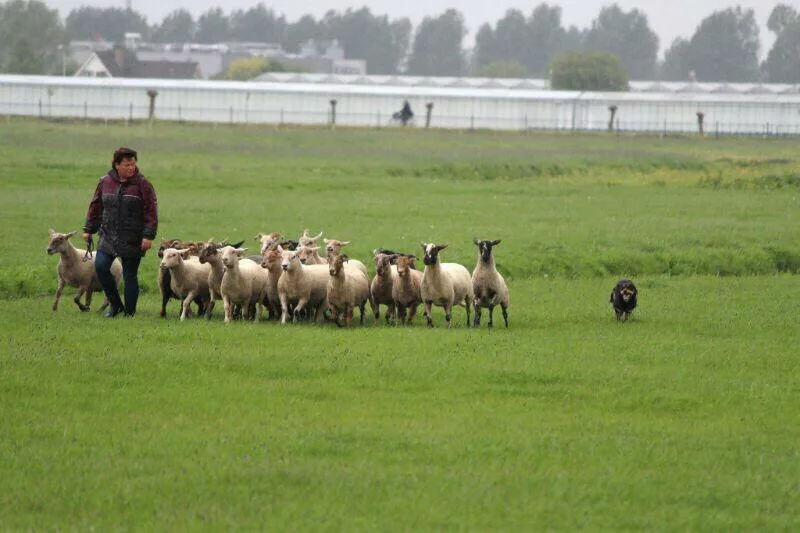
- A Working Kelpie learns sheep herding step by step: calm, position, balance, distance, and pressure.
- Initial training is not about speed, but about control and understanding the livestock.
- A good handler learns to observe both dog and sheep before adding commands.
- Applying too much pressure too early can cause unwanted chasing or unrest.
- Shepherds Working Kelpies trains from practical experience with dogs and flocks in Doldersum, Drenthe.
- When do you start with Working Kelpie training?
- The primary goal: control without pressure
- Key basic principles of sheep herding
- Common mistakes with young Kelpies
- Training in Doldersum and practical experience
- Step-by-step plan for the initial training phase
- Frequently asked questions
When do you start with Working Kelpie training?
Working Kelpie training does not merely begin the moment the dog is introduced to sheep for the first time. Preparation starts earlier with contact, calmness, basic obedience, and a strong relationship between dog and handler. The dog must learn that working together is rewarding, yet should not lose its natural instinct for livestock through excessive pressure or correction.
When a young dog is ready for its first introduction to sheep depends on age, temperament, maturity, and experience. Some dogs show interest and balance early on, while others require more time. The most important thing is that the initial experience is safe and positive, using suitable livestock and under the guidance of someone who can read both dog and flock.
The primary goal: control without pressure
The initial goal in sheep herding is not for the dog to immediately know all commands. The primary objective is for the dog, handler, and livestock to remain calm. A Working Kelpie must learn where to position itself to initiate movement, when to maintain distance, and when to release pressure. That requires more observation than speed.
In practice, this means the handler does not need to give constant verbal commands. Too many commands can inhibit the dog or cause further agitation. First, observe what the dog does naturally: does it seek balance, maintain contact with the livestock, stay responsive, and modulate pressure? Only then are commands logically paired with behavior that the dog already begins to understand.
Key basic principles of sheep herding
A Working Kelpie works using position, distance, and pressure. The dog influences the flock through where it stands, how fast it moves, and how much tension it builds. A subtle change in direction or pace can be enough to make sheep turn, slow down, or continue moving.
| Principle | What does it mean? | Why is it important? |
|---|---|---|
| Balance | The dog seeks the correct position relative to the handler and the sheep. | Without balance, herding becomes erratic or aimless. |
| Distance | The dog learns how close it can approach the livestock without causing panic. | Too little distance causes stress; too much distance yields no movement. |
| Releasing pressure | The dog stops applying additional pressure as soon as the sheep respond appropriately. | This teaches sheep to cooperate calmly rather than flee. |
| Timing | The handler intervenes at the right moment—neither too early nor too late. | Good timing prevents frustration for both dog and livestock. |
Common mistakes with young Kelpies
A common mistake is wanting to train commands too quickly, before the dog understands its effect on the sheep. Another error is continuing for too long when the dog becomes fatigued, overstimulated, or overly tense. Especially with a working-line dog, the exterior may still appear active even when its mind is already overwhelmed.
Drive is also sometimes confused with effective working behavior. A dog that runs hard, chases aggressively, or crowds the sheep is not automatically working well. Proper training helps channel that energy into control, composure, and cooperation. That is precisely why professional guidance in sheep herding is essential.
Training in Doldersum and practical experience
Shepherds Working Kelpies operates from Doldersum, Drenthe, near the Drents-Friese Wold. This environment makes training practical: dogs are not merely evaluated theoretically, but in relation to real animals, terrain, distance, and daily collaboration with a flock.
As a qualified veterinary nurse and long-time Animal Care lecturer, Erika Visser brings expertise in animal health, behavior, and learning processes. Catrinus Homan brings his practical experience as a second-generation shepherd. Together, they assess not only what a dog can do, but also what is responsible for dog, handler, and livestock.
Step-by-step plan for the initial training phase
- Start with calm and connection. Ensure the dog is responsive and the handler can work calmly.
- Choose suitable livestock. Use sheep that are safe and predictable enough for a novice dog.
- Observe natural instinct. Check whether the dog seeks balance, keeps appropriate distance, and responds to pressure.
- Introduce commands only later. Pair cues with behaviors the dog is already beginning to understand.
- Stop in time. Short, successful sessions are far more valuable than continuing too long with a fatigued or tense dog.
Inquire about Working Kelpie training
Frequently asked questions about Working Kelpie training for sheep herding
A Working Kelpie can start sheep herding once the dog is mentally mature enough, maintains adequate contact with the handler, and the initial introduction can be conducted safely. The exact age varies by individual dog. Temperament, aptitude, confidence, and guidance are more important than a fixed age limit.
Does my Working Kelpie need to obey perfectly before being introduced to sheep?
No, perfect obedience is not required, but basic connection and responsiveness are essential. In sheep herding, the dog also learns from its natural instinct. The key is not to stifle this instinct, while maintaining sufficient control so that dog, handler, and sheep remain safe.
Why is my Working Kelpie chasing the sheep too intensely?
Chasing too aggressively can result from tension, inexperience, insufficient distance, or an incomplete understanding of pressure. The dog wants to work, but has not yet learned how to pace its energy. Calm guidance helps the dog realize that position and balance are more important than speed.
How long does it take before a Working Kelpie can herd sheep well?
That varies greatly depending on the dog and handler. Some dogs demonstrate natural ability quickly, but reliable working ability requires time, repetition, and experience in diverse situations. The handler must also learn how to observe, time, and direct. Effective training is therefore not a quick fix, but a structured progression in stages.
Can I train on my own, or do I need guidance?
Practicing independently can be valuable, but guidance is strongly recommended during the initial steps. An experienced trainer can identify sooner when the dog is applying too much pressure, when sheep are experiencing stress, and when the handler should adjust positioning. This prevents bad habits and unnecessary tension.
Related articles
- Low stress stock handling in Working Kelpies
- What is the difference between a Working Kelpie and an Australian Kelpie?
- Buying a Working Kelpie puppy without livestock: when is it suitable?
- How do you choose a puppy from working lines?